SpectraFlux is an ultra-lean WebAssembly chassis for asynchronous workloads.

Need to bring a worker for SpectraGQL? Try SpectraFlux
SpectraGQL coordinates your microservices with CQRS at wire speed, but its write path relies on Bring-Your-Own-Worker (BYOW). Instead of writing and maintaining hundreds of lines of custom consumer daemon boilerplate, connection pools, and retry logic, drop in SpectraFlux. Write pure mutation logic in sandboxed WebAssembly fluxcells while the chassis handles the rest.
Monotonic HLC causality guards. 80/20 durable step memoization. Pooled RAII PostgreSQL transactions with auto-rollback on Drop.
Wasmtime instance pooling
Zero-compiler container
Per-core sustained dispatch
The 80/20 Idempotency Story
Why real-world mutations break on retries, why you can't architecturally side-step dependent state with multiple queues, and how SpectraFlux solves 80% of distributed durability with 20% of the complexity.
A mutation is almost never a single atomic step
Most developers think idempotency just means: "don't charge my credit card twice." But in real enterprise systems, an asynchronous mutation is an orchestration of mixed internal database writes and external third-party APIs:
Architectural NuanceWhy you can't architecturally side-step this by "splitting into multiple queues"▼
Developers often try to avoid idempotency by suggesting: "Just put the Stripe payment on one queue and the database write on another!"
Except Step 3 (PostgreSQL order commit) is causally dependent on Step 2 (Stripe authorization token). If Stripe declines the card, the database write must never happen. If Stripe succeeds, the database write must record that exact transaction token in the same row.
When internal state transitions depend on external API outputs, you cannot decouple them into independent fire-and-forget queues. You have an ordered pipeline inside a single logical unit of execution. If your worker pod crashes at Step 4, a naive broker redelivery will re-execute Step 2—charging the customer twice unless step results are memoized.
Standard Procedural TypeScript with ctx.step
No complex workflow deterministic state engines. No Cassandra cluster tax. Just clean business logic.
import { Context, Database } from "@spectraflux/sdk";

export async function handleCheckout(ctx: Context, cmd: CheckoutCommand) {
  // STEP 1: Idempotent External Side-Effect (Memoized in host Kevy storage)
  // On broker redelivery after crash, returns in < 50µs WITHOUT re-charging!
  const charge = await ctx.step("stripe_charge", async () => {
    return await stripe.charges.create({
      amount: cmd.amountCents,
      currency: "usd",
      source: cmd.paymentToken,
      idempotency_key: `checkout_${cmd.orderId}`
    });
  });

  // STEP 2: ACID Relational Commit (Pooled PostgreSQL)
  // Causally dependent on Step 1 output (charge.id).
  // RAII Guard: If the worker panics or times out, pending SQL rolls back instantly.
  const tx = await Database.beginTx();
  await tx.execute(
    "INSERT INTO orders (id, user_id, charge_id, total, status) VALUES ($1, $2, $3, $4, $5)",
    [cmd.orderId, cmd.userId, charge.id, cmd.amountCents, "PAID"]
  );
  await tx.commit();

  // STEP 3: Out-of-Band Downstream Event Dispatch
  await ctx.publish("orders.confirmed", { orderId: cmd.orderId, chargeId: charge.id });
}The 100/100% Saga Model vs. SpectraFlux 80/20
Why run heavy distributed saga engines when 90% of your mutation workloads execute in under 5 seconds?
The 100/100% Heavy Saga Model
Temporal / Cadence / Heavy Event-Sourcing
Compiled into full event-sourced deterministic state machines where every variable assignment and function call is logged to a central orchestration cluster.
SpectraFlux 80/20 Sweet Spot
ctx.step Memoization + RAII PostgreSQL
90% of business mutations execute in 100ms to 5 seconds. SpectraFlux memoizes external side-effects locally and rolls back dirty SQL transactions automatically on failure.
The 20% We Do Not Solve
Solving challenging problems elegantly means knowing where to limit scope. If your requirements fit any of these four criteria, SpectraFlux is not the right solution:
From 16MB dense micro-workers to 4GB heavy domain modules
Fluxcells are not restricted to one mutation per file. A single fluxcell can subscribe to multiple topics (["orders.checkout", "orders.refund", "orders.cancel"]) or export multiple REST routes (POST /verify, GET /session), forming a cohesive domain module.
In 32-bit WebAssembly (wasm32-wasip1), linear memory reaches up to 4 GB per cell. SpectraFlux supports lightweight 16MB–64MB transaction cells with pre-warmed instance pooling side-by-side with 4GB batch workers using virtual memory demand paging.
Hardware-Isolated Chassis & Decoupled Storage
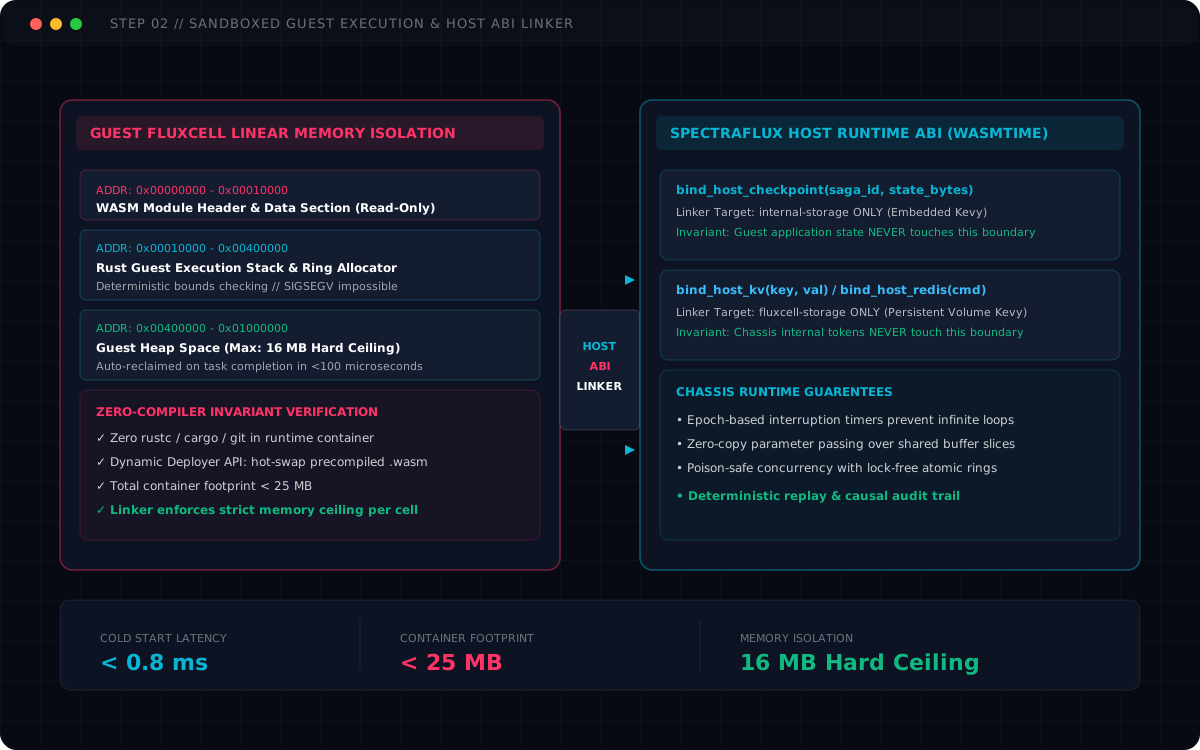
SpectraFlux couples a hardware-isolated WebAssembly execution chassis with strictly partitioned storage tiers. Host ABI security boundaries guarantee that guest fluxcells cannot tamper with chassis operations, while PostgreSQL standardizes ACID relational state.
The Wasmtime Execution Chassis
A high-velocity, single-binary appliance built on Wasmtime. Eliminates container sprawl by running dozens of micro-workers inside one memory space with hardware-enforced isolation.
Domain-Rich FluxCell Sandboxes
Fluxcells are compiled WebAssembly modules representing bounded contexts. A single cell can subscribe to multiple event topics and serve HTTP REST routes within one cohesive module.
POST /_flux/deployer/upload in < 200ms with zero downtime and atomic staging.Strict Storage Partitioning & Linker Boundaries
Chassis Internal Storage
Dedicated exclusively to chassis framework operations: Saga state checkpoints, magic-link OTP tokens, session cache, and domain traces. Host ABI bind_host_checkpoint writes strictly here. Guest cells cannot read or modify this space.
Fluxcell Application State
Dedicated exclusively to guest fluxcell application state, KV operations (kv_store), and Redis wire protocol commands (host_redis). Supports persistent volume mounts with fail-safe local dev fallback to ./data/.
Relational Storage (Postgres or Bust)
SpectraFlux standardizes exclusively on PostgreSQL for persistent relational storage to eliminate dialect fragmentation and avoid container bloat. Database migrations are plain SQL files embedded at compile time (include_str!).
Deploy Micro-Workers in Milliseconds
Fluxcells compile in CI/CD to immutable wasm32-wasip1 binaries and hot-swap into the live running chassis via API in < 200ms—with zero container restarts and zero dropped broker messages.
Dynamic Deployment & Broker Topic Wiring
Click any phase to inspect how topics are declared, authenticated, dynamically wired to broker streams, and hot-swapped in 184µs.
Live Fluxcell Telemetry & Security Controls
| Cell Identifier | State | Memory / Limit | Cold Start | Attached Routes / Topics | Invocations |
|---|---|---|---|---|---|
orders_workerv2 (184µs swap) | ACTIVATED | 18.2 MB / 64 MB | < 0.4 ms | ["orders.checkout", "orders.refund"] | 142,850 |
magiclink_authv1 | ACTIVATED | 12.1 MB / 32 MB | < 0.3 ms | POST /verify, POST /send-otp | 89,402 |
nightly_batchDedicatedWorker | STANDBY | Scales to 4 GB (VMem) | On Demand | cron(0 2 * * *) | 1,420 |
How SpectraFlux compares to the alternatives
Every backend architecture makes deliberate trade-offs. Here is why teams choose SpectraFlux over container workers, general WASM frameworks, or heavy workflow orchestrators.
| Evaluation Vector | Container Workers Node.js / Go + BullMQ / Kafka | General WASM Fermyon Spin / WasmCloud | Heavy Orchestrators Temporal / Camunda / Inngest | SpectraFluxSweet Spot Event-Driven Micro-Worker Chassis |
|---|---|---|---|---|
Cold-Start Ingress Latency Time from broker message receipt to guest execution | 2 – 10 seconds (pod launch) | < 1 ms | 50 – 200 ms (state roundtrips) | < 0.8 ms (instance pooling) |
Memory Footprint & Density Resource cost to run 50 background workers | 5 – 15 GB RAM (50 separate pods) | ~150 MB (separate runtimes) | Massive (cluster + DBs + daemons) | < 25 MB chassis (allocates 16 MB pooling up to 4 GB) |
Out-of-Order Broker Handling Preventing race conditions & data corruption | Naive ACK/NACK (stale writes corrupt DB) | No built-in causality support | Event-sourced deterministic replay | Built-in Monotonic HLC CausalGuards |
Side-Effect Durability (Retries) Preventing duplicate Stripe charges on broker retry | Manual code; retries repeat side-effects | No native step memoization | Full multi-week saga replay | 80/20 Durable Steps (ctx.step memoization) |
Deployment Cycle Time Deploying a single worker bug fix to production | Slow (CI build Docker, push, roll pods) | Moderate (SpinKube / lattice manifests) | Tied to container rolling restarts | Instant hot-swap via API (< 200ms, 0 downtime) |
Operational Overhead Infrastructure required to run in production | High container sprawl (pod fleets) | Moderate to high (custom orchestrators) | Extreme cluster tax (dedicated Temporal) | Zero cluster tax: single drop-in appliance |
Container Workers
Node.js / Go / BullMQ / KafkaJS
Traditional background worker containers
General WASM
Fermyon Spin / WasmCloud
Serverless WASM HTTP & actor lattices
Heavy Orchestrators
Temporal / Camunda / Inngest
Distributed multi-day saga engines
SpectraFlux Appliance
SpectraFlux Wasmtime Chassis
Event-driven micro-worker execution chassis
Frequently asked questions
Everything you need to know about SpectraFlux, 80/20 idempotency, fluxcell granularity, and architectural trade-offs.
Why would I choose SpectraFlux over traditional Node.js or Go worker pods?
How does SpectraFlux solve inconsistent state problems across microservices?
How does the 80/20 durable step (ctx.step) compare to Temporal or Inngest?
When should I NOT use SpectraFlux?
Do I have to use SpectraGQL to use SpectraFlux?
What is the 'Zero-Compiler Container' invariant?
Why are internal storage and fluxcell storage strictly decoupled?
Why does SpectraFlux require PostgreSQL for relational storage?

High-velocity WebAssembly workers for your write path
Deploy the ultra-lean execution chassis that eliminates duplicate side-effects, runs 50 micro-workers in a single container, and provides 80/20 durability without cluster bloat.
Ultra-lean < 25 MB container.
OPEN SOURCE · MIT LICENSED · NO SAAS TIER